


Introduction: A Walk Through Vicenza’s History
It is a summer evening in Vicenza, Italy. Heralded as the City of Gold (for its jewelry production) and as a UNESCO-World Heritage site (for its unparalleled stock of Palladian architecture), I entertain the possibility that it might also qualify as the World’s Most Beautiful Open-Air Oven. Even at nine in the evening, the heat of the day radiates from the baked limestone pavers of Piazza dei Signori—the city’s main square—and ricochets from the ancient stone and brick-stucco buildings along the perimeter.
To my right stands the city’s most iconic building: the imposing Basilica with its rectangular, patinaed dome. To my left, the pink and cream Loggia del Capitaniato sprouts from the piazza’s edge like a square, columned giantess. Both of these buildings bear witness to Palladio’s architectural genius, but that is not why I am here.
Because why I am here remains straight ahead, to the eastern end of the square, in the form of two Corinthian columns rising 57 feet (17.5 meters) in the air. A statue of Christ the Redeemer tops the column to the right. Atop the column to the left, a statue of Venice’s famous winged lion—also known as the Lion of Saint Mark—stands with a hind leg raised on a rock, tail curled upward, its head turned to watch passersby below.
I’m here for the lion.

The Tale of the Tail: A Copper Legacy in the Sky
Most people with any interest might easily discover that the lion was first ensconced in the late 1400s, when the Most Serene Republic of Venice claimed control over Vicenza. Feuds and wars have seen the lion come and go over the centuries, but it always found its way back to this pedestal above Piazza dei Signori. In 1797, Napoleon dismantled the lion and stored it within a warehouse in a state of disrepair. Refurbished and remounted after the unification of Italy in late 1800s, the lion had a steady run until bombs blew off its tail in World War Two. It’s this last bit that captures my interest.
Now, as I peer at the lion from 57 feet below, I see what most people may not:
A little knob, just about halfway up the lion’s tail. This is the spot where Luigi Dal Toso, the proprietor of Vicenza’s historic copper shop, climbed rickety scaffolding in 1960 to attach a new copper tail. It is the same tail we see today. Since it is painted and textured to match the white of the lion, one would never guess that the artisan behind that tail— and his son Igino Alessandro Dal Toso—still make hand-made copperware in town.
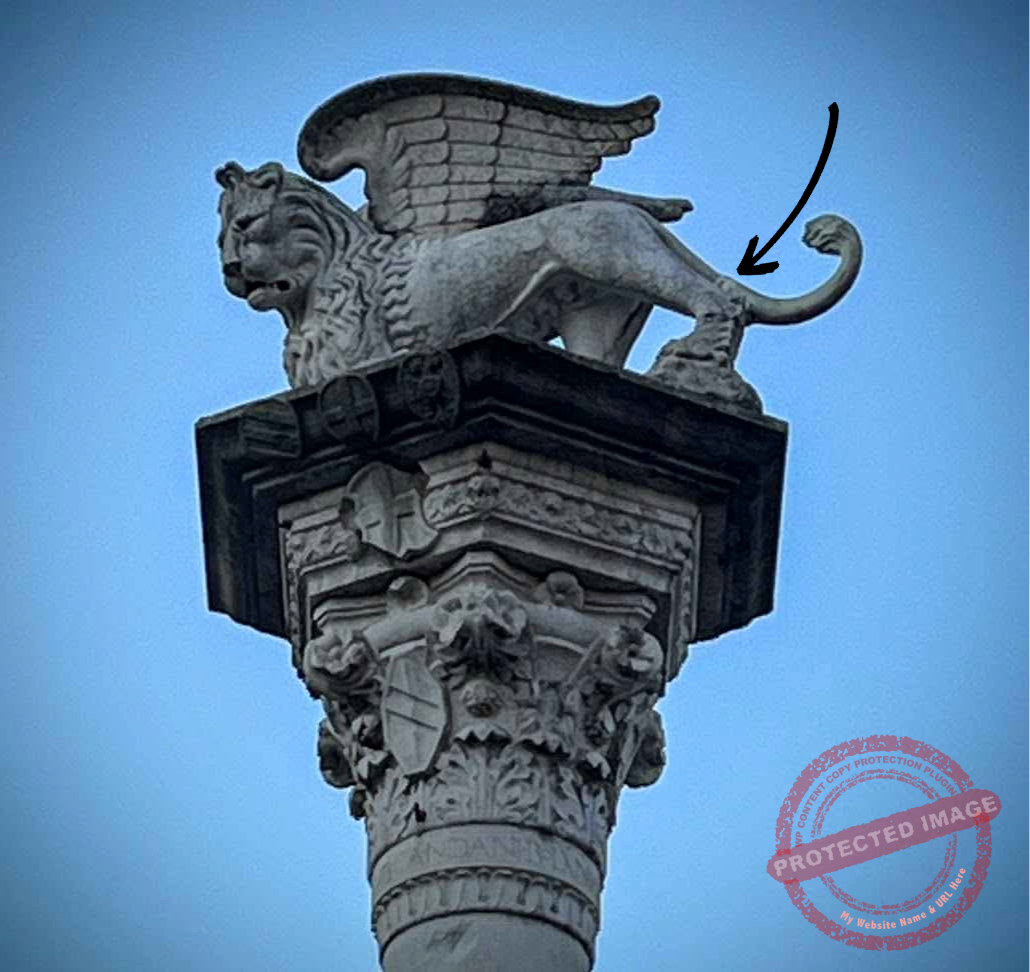
This is a tale of a tail. But it isn’t really. This is a tale about a family that has passed down skill and fidelity to artisanal copperware from generation to generation. It is about Vicenza’s historic copper shop, Bottega Storica Dal Toso, where the Dal Toso family has made beautiful, durable, hand-crafted copper pots, cauldrons, baptismal fonts, brewery stills … and lion’s tails … since 1896.
Shall we begin?
Finding Bottega Storica Dal Toso: Hidden Gem in Vicenza
It is Thursday on a late afternoon, and I’m riding my bike over Vicenza’s Angel Bridge, now turning down a bumpy, arcade-lined street. I pass through an arched portal, Porta Santa Lucia, which marks one of the ancient gates of this walled city. I stay straight, hopping across a busy road, then turn right onto Via Livio Zambeccari. I stop at the second building on the right.
If I had not made this appointment to meet with Igino Alessandro and his father Luigi, I would never have guessed that this unassuming spot would be the place to find one of the few remaining artisanal copper shops in all of Italy. Facing the street, a modest window displays various copper pieces, the metal glinting a rich rosy-bronze in the sunlight. On the wall to the right of the door, a tiny sign indicates the shop: Bottega Storica Dal Toso dal 1896.

As I enter, a bell tinkles.
Inside the Shop: Where Copper Becomes Art
Igino Alessandro stands by a wide, battered workbench, the surface scattered with hammers of various shapes and sizes. He greets me with a smile and introduces me to his father Luigi, who stands across from the workbench, hammering a copper pot against an enormous anvil.

As Luigi continues tapping away, Igino Alessandro (who goes by “Igino” with friends and family, but explains that, because it is an unusual name in these parts, he uses “Alessandro” professionally) shows me around the tiny shop.
Items hang from the ceiling and spill over shelves. I examine the glittering pots and pans and buckets and pitchers and vintage bed warmers, gelatin molds, trays, bowls, bracelets, carafes and decorative plates with exquisitely hand-tapped, convex designs, and I am struck with the notion that I’ve entered Aladdin’s cave of treasures.

Have they made all of these things? Mostly, Alessandro answers with a proud smile. But some items have been brought in for refurbishing. In addition to making copperware, he explains, they are also the go-to source for refurbishing all items copper related.
“One of my favorite things about my work,” he says, “is when a customer brings in an item for repair. Perhaps it has been something they have had in the family for generations, or perhaps it is something they picked up at the antique market. They always come here, and sometimes, I realize that it is a piece that my great-grandfather made! It is a special moment.”
Once these pieces are restored, Alessandro explains, they can be used for another century. “Not just for decoration,” he emphasizes, “but actually used on a daily basis.”
I gaze around the shop, feeling mildly overwhelmed. So much history. So many questions. Luigi has moved from the bucket and is now polishing a decorative copper basket with a wad of well-used steel wool.
Alessandro takes the lead. He’s been running the place mainly on his own for over a decade now, so he is used to answering questions. He himself started working here full time when he was about 26 years of age. Before then, he’d studied as an accountant before serving in the military. When he finished his service, he began working here, training for seven years under his father’s tutelage. It wasn’t until his early thirties that he began creating pieces on his own. “Not like my father,” he says with a smile. “He started working here as a boy. Do you want to hear the history?”
I do. I grab my pen and notepad, and begin scribbling away.
A Family Tradition: Over 125 Years of Artisanal Copperwork
The shop that we are standing in began in 1896, he begins, clearly skilled at showing people around. Several articles have been written about the place, after all, and it is the only shop in this area of the country that still makes copper items completely by hand. “The only machine I have is one used for polishing,” he says.
“How many copper places remain artisanal?” I ask.
Alessandro thinks that over for a minute. “I would say perhaps seven or so, including ours.”
“In the entire country?”
“Yes. Mostly in the south, perhaps one to the north,” he says. “There are other places that produce copperware, of course, but not by hand.”
But back to the history of this magical place:
The Bottega Storica Dal Toso was started by his bisnonno (great-grandfather) Augusto Dal Toso, but it was actually his great-great grandfather, Alessandro Dal Toso, who kicked the copper trade off for the Dal Toso clan. He had owned an iron and copper shop elsewhere, but this specific location has been in the family since 1896.
When Augusto opened this bottega in Vicenza, he made practical kitchen and household items: sauce and polenta pans, water buckets, cauldrons for cheese-making and bed-heating pans. They also made copper tanks, which were used on the vineyards that cover much of Italy’s fertile soil. I’m especially interested in this last item, so Alessandro explains that the tanks were used for a treatment called “Green Copper.”*

When his grandfather (and namesake) Igino took over the shop, he co-founded the artisan guild in Vicenza—a consortium of like-minded art and crafts people that thrives to this day. Then, there were seven members. Now, there are around 20,000. Over time, Igino became the director of the Artisans’ Mutual Fund of Vicenza and was also knighted by the President of Italy as a Knight of the Republic.
By the time Alessandro’s father Luigi came along, the shop was thriving. It was not until the wizened age of fourteen, however, that Luigi began working there full time. During the day, Luigi hammered away at pots and pans, and at night, he attended the Scuola D’Arte e Mestieri in town. While the school focused more on jewelry design than on copperware, Luigi used this bias to nurture his creativity. He sketched people and drew artistic designs, and after six years of study, he graduated with a vision to bring his artistry into the copper shop.
So maybe this is a tale of a tail, after all. It was Luigi’s artistry that caught the city’s attention when he was approached with the task of restoring the Lion of Venice. Over several years now, the shop had gained a reputation for original, creative designs. Commissions from cathedrals began rolling in for copper baptismal fonts and thuribles. Today, Alessandro tells me with modest pride, almost every church in Vicenza has something from this shop.
In addition to designing and creating copper pieces that served both form and function, Luigi began experimenting with more free-spirited ideas. In the 1960s, he began making copper belts, selling them to tourists in Venice. He estimates he sold around 5000 of these—largely to the French and English. As Alessandro translates, Luigi digs around in a bin, then displays such a belt to me.
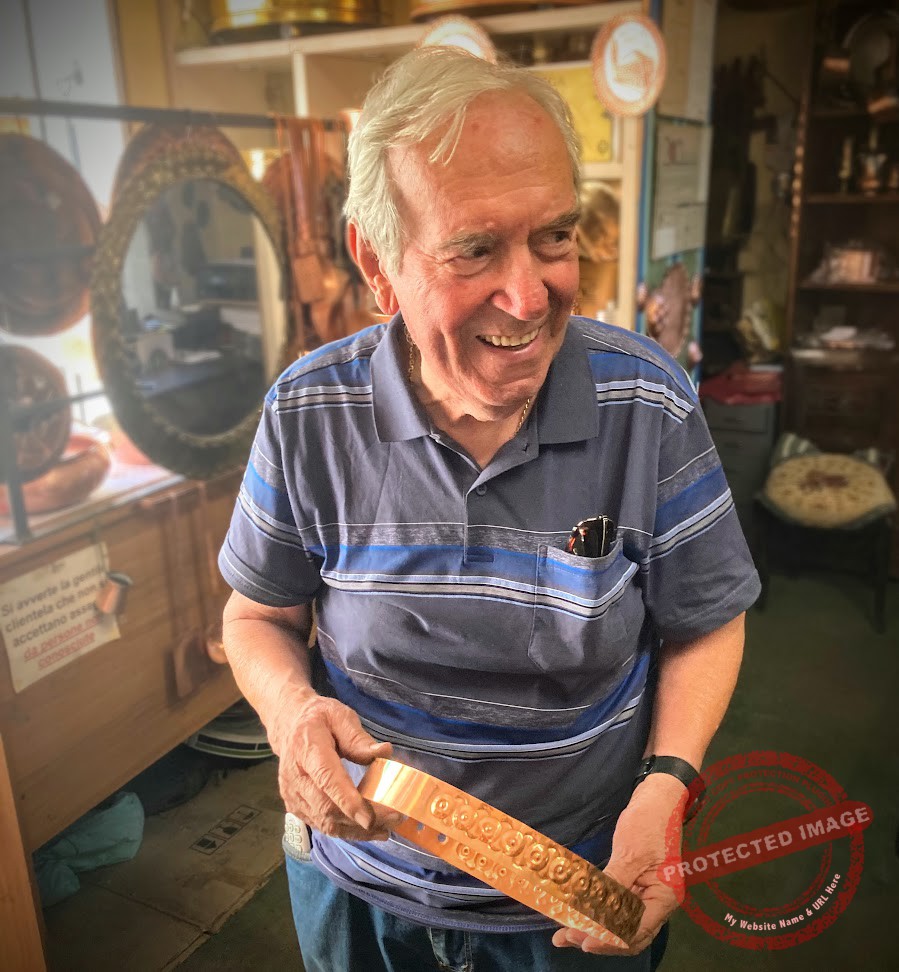
It is beautiful, decorated with hand-chiseled, embossed flowers. I think they may be frangipanis, but am unsure how to ask. It is also tiny. I am reminded once again how humankind has changed in size, even as recently as the 1960s.
Alessandro admires the belt his father holds with a smile. “He made all kinds of things,” he says. “I even found some of his old designs. Look!” And he pulls out a box from under the display shelf with a half-dozen scrolls of yellowed paper. Uncurling one, he shows an ornately embossed trophy cup. The drawing alone is a work of art.
“So, he would draw these in such detail first, before making the physical version out of copper?”
Alessandro shrugs. “Of course.”

I stare at the sketch, amazed by the skill and the hours gone into a singular item.
“What is your favorite thing to make?” I ask Alessandro.
He points to the decorative, embossed plaques and plates. “These,” he says. “They are very difficult because I must first create the item—in this case this platter,” he points to an enormous serving platter with fluted edges. In the center of the platter, a wooden frigate with billowing sails rolls over a churning sea. It is incredibly detailed.


“Then, I must sketch the outline of the design, then I must carefully heat the copper so that I can tap out the outline, and then, to emboss, it is very technical. There is a balance between heating it without ruining the design thus far and working with enough speed to shape the metal before it cools. It can take a very long time.”
“And you do all of this by hand? The shaping … all of these details?”
Alessandro nods. “Everything by hand.”
Craftsmanship That Endures: How Copperware Is Made
He gestures to the array of vintage hammers scattered over the work table, then to the anvils that lurk about the room, one small and rounded, another a giant block of iron. “Most of these are over a hundred years old. The ones with ‘PC’ engraved on them, for instance, are even older than the shop.”
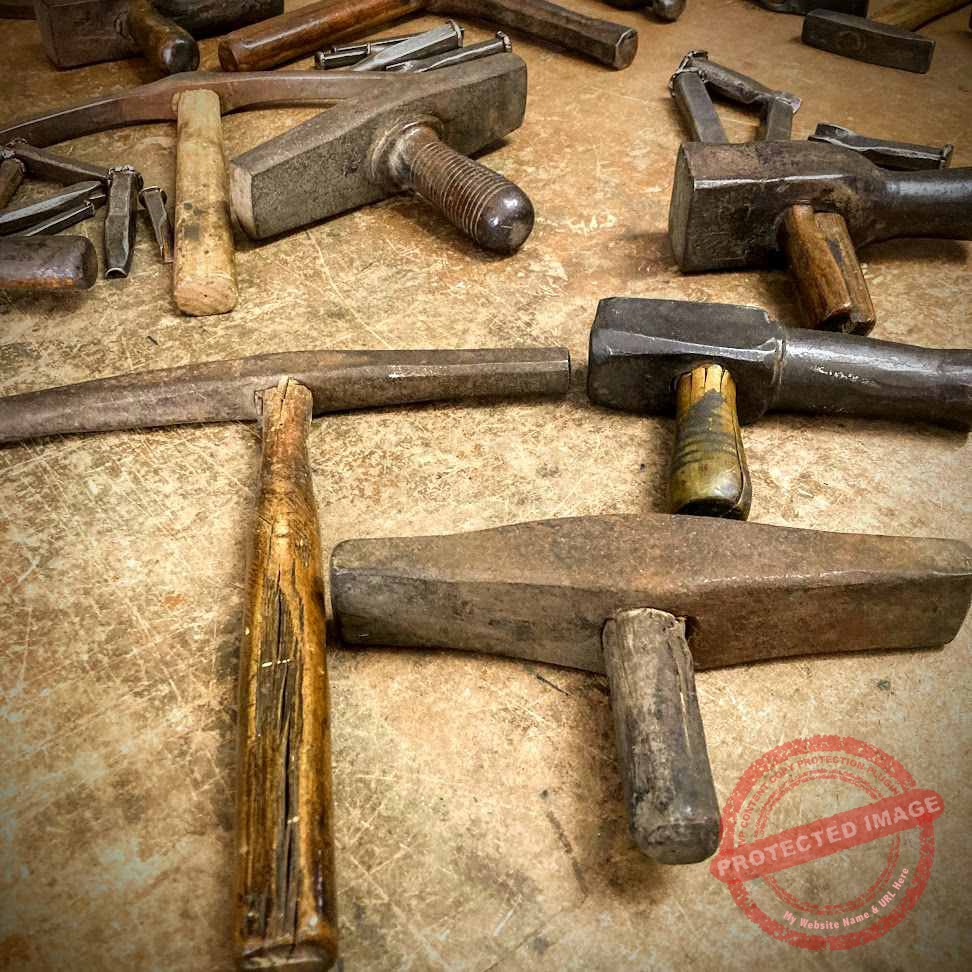
I circle the workbench to take a few photos. “And the heating?” I ask between clicks. “How does that work?”
Alessandro walks over to a nondescript door at the back of the shop and opens it, revealing a dark workroom with a singular window. Mercifully, he has the window open for the breeze. Even without a fire going, it is warm in here.
“This used to be the fireplace,” he says, pointing to a raised stone structure, “but now I use a torch. To shape the copper for anything, it must be heated. And of course for many of the cooking items, the interior must be lined with tin. To do that, I must melt the tin first, which requires heat at around 230 degrees [446 degrees Fahrenheit]—and even hotter if the tin needs to be thicker—then fused onto the copper. The only pots that do not use tin are those that are specifically for foods with no acidity, such as polenta and some cheeses.”

Igino Alessandro showing tin lining to be fused into the copper pot
I gaze at the pots glowing in the darkened room. “What about the handles?” I point to one. “Are these made of brass?”
“Yes. We use brass for all of the handles because they do not conduct heat as easily, so they stay much cooler than the copper. But nowadays, I buy the brass handles in bulk, then shape them here.”
“By heating them up, then shaping and cutting?” I ask, wiping sweat from my forehead.
Alessandro nods again. “As you can see, there is a lot of work with fire. It gets very hot.”
He points to the ceiling, where decades of flame have blackened what appears to once have been a white, stone ceiling. “For a while, I had considered rehabilitating it, but now I think I will keep it the way it is. It shows the history.”
It certainly does. I step back and crouch, attempting to capture a section of the ceiling while keeping the pots and worktable in the frame.
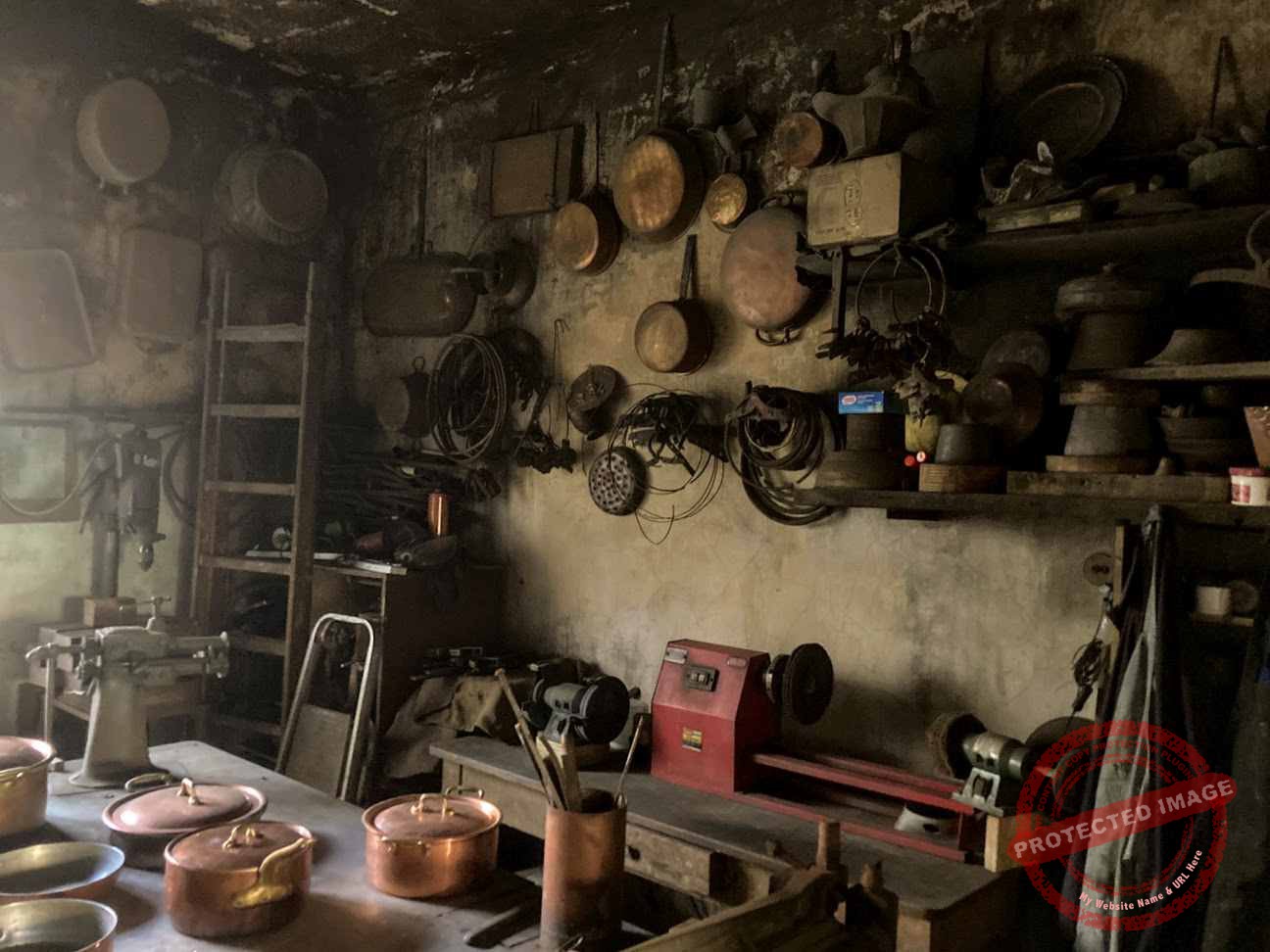
“The photographers love to come here to take photos of the pots,” he offers knowingly. “The lighting is beautiful.”
He arranges a few items on the windowsill. I click away.
Back into the shop area, Luigi shakes my hand with a smile, then departs via the shop’s side door. I watch him leave, wondering what it must be like to belong to such a place. Fulfillment and dignity are words that come to mind.

Alessandro is now discussing the nuts and bolts of copperware. I ask for clarity on his previous comment about acidity, and am told that most foods contain acid, which erodes the copper. Artisanal pots and pans will almost always have a tin lining—those pots lined with steel are made in industrial shops.
“Why were so many cooking pots and pans traditionally copper?” I ask.
Turns out, for many reasons. Copper is more resistant to bacteria, and it is also a superior heat conductor. Because copper pots cook at lower temperatures, you save time and energy consumption because you use less heat. “Because it heats so quickly and easily, you must cook with liquid inside, such as water, oil or butter, to keep the food from burning.”
He grows enthusiastic about the properties of heat conduction. I scribble down notes as he estimates the heat conduction in each commonly used metal:
Rame (copper) is about four times hotter than Ghisa (cast iron), about one and a half times hotter than Aluminio (aluminum) and close to twenty times hotter than Acciaio (steel).
Global Reach: Handmade Copperware Around the World
We’re back at the display table, where the assortment of everything-copper twinkles in the sun. I ask if any of their products are sold globally.
He smiles. “We sold a large cauldron to a cheese-maker in the United States,” he says. “Our products have ended up there, in China, Japan, Australia … all over the world.” Alessandro says that the products are usually purchased in the shop, then shipped by the purchaser to the final destination. “We always send instructions on how to care and clean for them.”
Shopping for Copper in Vicenza: What to Buy and How to Clean
And how does one care and clean for such a piece?
Apparently it is quite simple: A solution of white vinegar and table salt, lightly rubbed with steel wool.
From somewhere beyond, a church bell chimes seven times. I had no idea I’d been here for an entire hour. Time for some quick shopping. As I pick out a polenta pot and a tin-lined frying pan, I ask Alessandro how long it takes him to make an item like this. He considers the pan.
“No less than four to five hours,” he says. “That is if I can work on it with no interruptions. Some things take much longer, but nothing takes less time than that.”

Alessandro notes that the pan I selected is lighter than others. Copper kitchenware varies in thickness, depending upon the intended use, he explains. While thicker copperware is usually equated with higher quality products, there is a reason for thinner pans, too. They are lighter, of course, and so the lighter pans offer greater freedom of movement. I lift a heavier pan with both hands, then try the lighter one with a flick of my wrist. That’s the one I want.
He wraps the items individually, slipping in an informational sheet on the care and cleaning. A tap of my credit card over his portable payment device, and now, I am the proud owner of a copper polenta pot and a frying pan.
My purchases fit perfectly inside my bicycle basket. Alessandro waves me arrivederci as I pedal away, retracing my route to home. As I head up Corso Palladio, struggling a bit up the hill that marks the highest point of city central, I pass by the historic palaces and government buildings that line each side. I notice a copper plaque on one building, and over there, just inside a shop door, a copper umbrella stand. I’m now pedaling by an ancient church, and I am sure that inside, something beautiful and copper glints in the dusky light.
I am thinking again of Luigi and Alessandro, of what it must be like to come from such a heritage, to spend each day in a place that is uniquely yours, bearing witness to your life and creativity and effort and devotion. To have your works and those of your ancestors all over the city you call home, and to know that you are just as much a part of its history as you are of its future. And I realize that one hour in that shop has changed the way I see this City of Gold.
Because now, I also see copper.
*(Upon a little research, I now understand that this “Green Copper” treatment is comprised of mixing copper sulfate with lime and water, and stored inside copper tanks. This mixture is then sprayed on the grape vines which, in turn, served as both a fungicide and insecticide.)
Visit Bottega Storica Dal Toso

Bottega Storica Dal Toso (dal 1896)
Address: Via L. Zambeccari, 29, Vicenza, Italy 36100
+39 0444 513019
1896daltoso@libero.it
In addition to treasure chest of stocked items, Alessandro and Luigi fulfill special orders and customize products. Once, Alessandra engraved the face of someone’s beloved on an ornate vase, going solely on a photograph—I saw the photos of the reference as well as the end product. Astonishing, to say the least! They also retrofit cookware to be suitable for induction heating.
References:
https://www.palladianroutes.com/post/the-lion-of-san-marco-in-vicenza